- Sep 09, 2025
From Birth to Death, the LA Phil Explores Life’s Journey
By Harlow Robinson
Composer Ellen Reid applauds the LA Philharmonic at the premiere of Body Cosmic at the Hollywood Bowl. | Credit: Elizabeth Asher, courtesy of Los Angeles Philharmonic Association
The topic of pregnancy is not often addressed in classical music — a field that has traditionally been dominated by men. Even in works by the great women composers of the past, the intimate experience of creating new life has remained largely unexplored.
Ellen Reid’s Body Cosmic, which received its Los Angeles premiere on Sept. 4, is a welcome exception to this pattern. Co-commissioned by the LA Philharmonic and a consortium of other orchestras, the work is a “meditation on the human body as it creates life and gives birth,” celebrating the joy and wonder of childbearing as it follows the course of Reid’s own recent pregnancy. Judging by the music’s warm, exuberant soundscape, it was a happy experience.
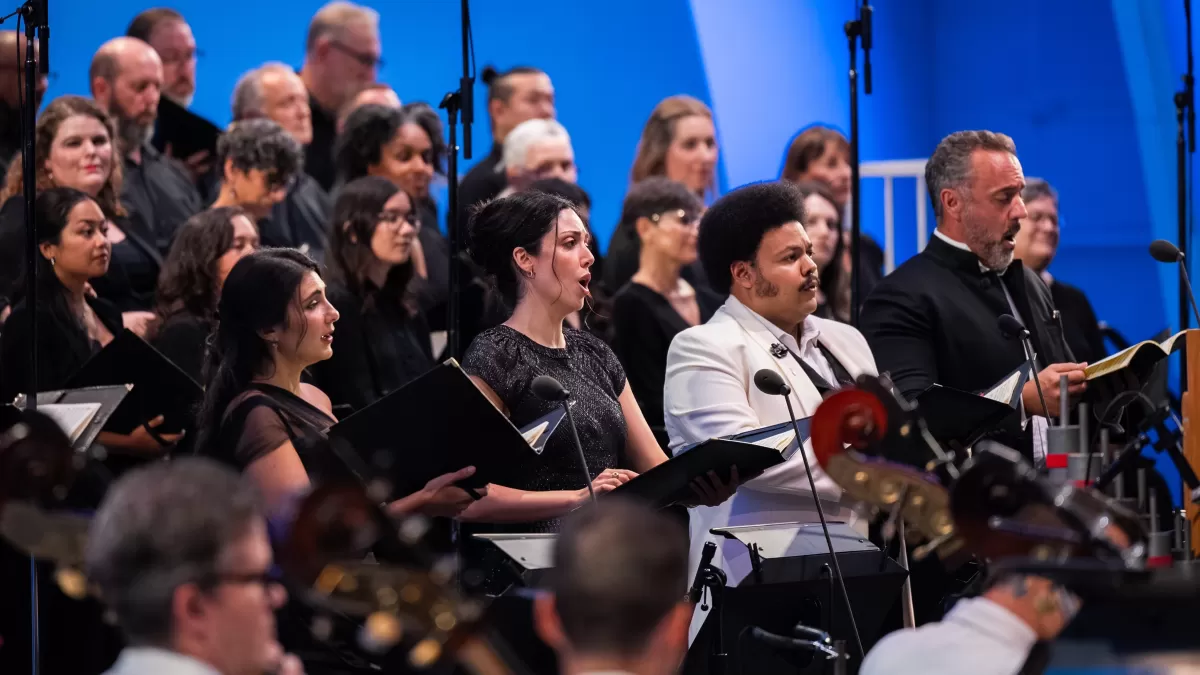
Soprano Elena Villalón, mezzo-soprano Isabel Signoret, tenor Joshua Blue, and bass-baritone Christian Van Horn were soloists in Mozart's Requiem at the Hollywood Bowl. | Credit: Elizabeth Asher, courtesy of Los Angeles Philharmonic Association
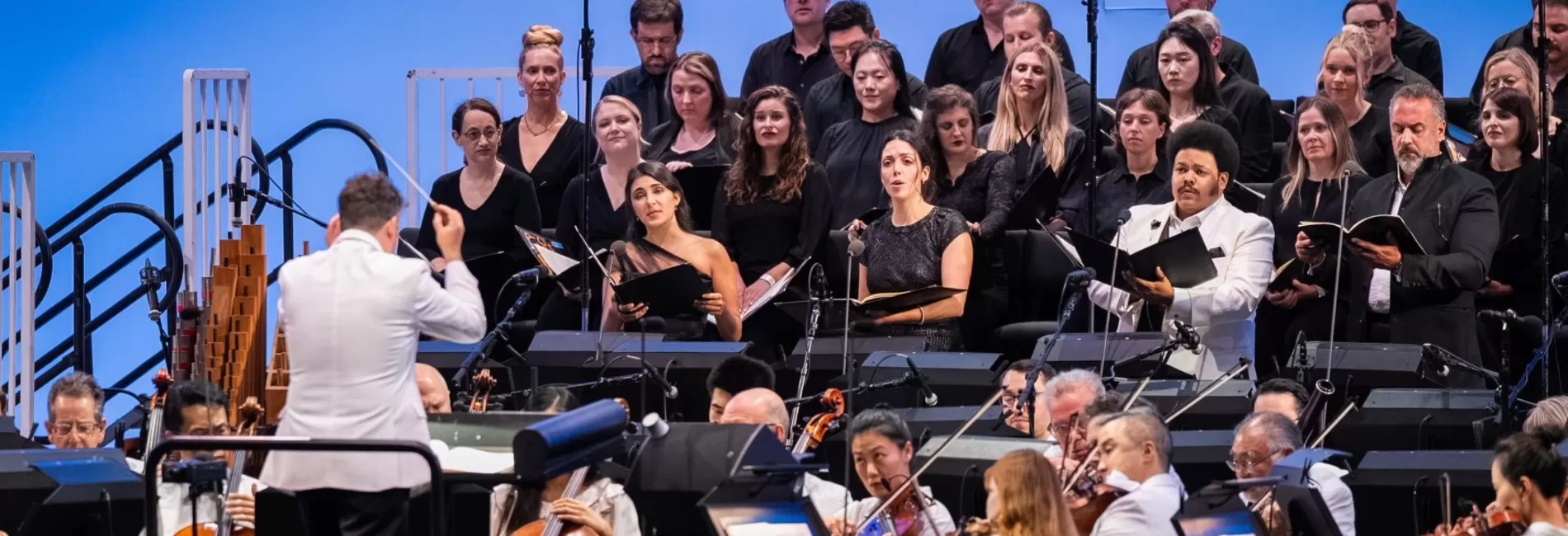
With American conductor James Gaffigan securely at the helm, the program also included two masterpieces of choral spiritual music: Schicksalslied (Song of destiny) by Johannes Brahms and Wolfgang Amadeus Mozart’s storied Requiem. Both received poetic and moving performances by the Los Angeles Master Chorale, joined in the Mozart by four renowned soloists (soprano Elena Villalón, mezzo-soprano Isabel Signoret, tenor Joshua Blue, and bass-baritone Christian Van Horn).
While no one will mistake the Hollywood Bowl for a church, the evening felt like a welcome spiritual respite for the large congregation gathered on a warm night under the stars.
Before the music started, LA Phil President and CEO Kim Noltemy appeared onstage to acknowledge the many creative contributions of retiring concertmaster Martin Chalifour, who was making his final appearance with the orchestra after a 30-year career.

Composer Ellen Reid | Credit: Erin Baiano
Ellen Reid has for some time made Los Angeles her second home and has worked with all of the city’s major classical music institutions. She won the 2019 Pulitzer Prize for Music for her opera p r i s m, which deals with the topic of sexual assault and premiered at REDCAT in November 2018. And on Sept. 25, Gustavo Dudamel will conduct the world premiere of her Earth Between Oceans in the first concert of his farewell season with the LA Phil.
Body Cosmic has two sections: “Awe | she forms herself” and “Dissonance | her light and its shadow.” Ascending scales dominate in the first, beginning softly in the strings and harp, then building as the brass enters, representing the growth of a new life in the womb. The first violin has several gently impassioned solos, and Chalifour made the most of them for his valedictory.
Tension builds in the second half, as birth draws near. “Smearing” brass and what sounds like the ticking of a clock in the percussion end in an explosion from the entire orchestra — the entry of a new person into what Reid describes as a “simultaneously beautiful and crumbling world.” As in her other recent works, Reid excels here in creating an evocative and inviting sonic landscape, using techniques from her varied experience in opera, sound design, film scoring, avant-pop, ensemble, and choral writing.
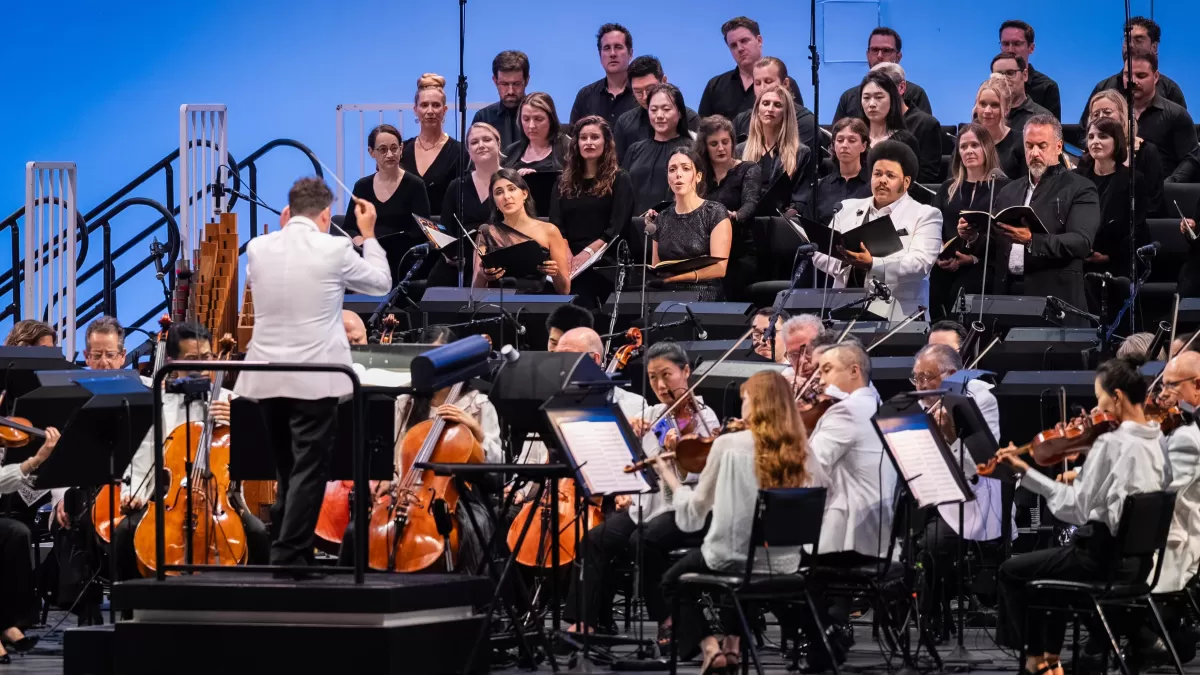
LA Philharmonic, LA Master Chorale, and soloists, conducted by James Gaffigan, perform Mozart's Requiem at the Hollywood Bowl. | Credit: Credit: Elizabeth Asher, courtesy of Los Angeles Philharmonic Association
That piece was followed by Brahms’s Schicksalslied (Op. 54, 1871). Often called Brahms’s “Little Requiem,” the work sets verses by the poet Friedrich Hölderlin (1770–1843), contrasting the tranquil life of the gods in heaven with the brutish, doomed life of us mortals below. The orchestra gave a glowing account of the romantic lyricism of the gods’ abode in the orchestral introduction and first choral section, with hushed and beautiful singing from the chorus. To my taste, the second section needed more dynamic and rhythmic intensity to contrast with the return of the peaceful theme that provides solace at the close.
Mozart’s Requiem also portrays the heaven that awaits the virtuous and the hell that awaits the sinners (the fiery “Dies irae”). Famously, Mozart himself was dying as he composed the Requiem and didn’t live to finish it. Later, his student Franz Xaver Süssmayr completed the score and wrote the last three sections (“Sanctus,” “Benedictus,” and “Agnus Dei”) himself, along with finishing and orchestrating other sections. In style, Süssmayr’s contributions do in fact sound more square and conventional than the sections penned by Mozart.
Popularized in film and drama, the Requiem still rarely disappoints in concert, and this performance was no exception. Choral entrances were precise and clean in the many fugal sections, with delicately controlled dynamics and fine balance between the upper and lower voices. All the soloists made distinguished contributions, but British American tenor Joshua Blue was the standout, with a clarion tone that bounced beautifully around the canyon.
Harlow Robinson is an author, lecturer, and journalist. His books include Sergei Prokofiev: A Biography and Russians in Hollywood: Hollywood’s Russians. His writing has appeared in The New York Times, Los Angeles Times, The Boston Globe, Musical America, and Opera News. He is emeritus professor of history at Northeastern University.
MORE PRESS COVERAGE
View More
Los Angeles Master Chorale Will Present SOUND WAVES at Walt Disney Concert Hall...
May 12, 2026
Fanny Mendelssohn’s “Cholera Cantata” Finds New Life in Post-COVID Perform...
Apr 21, 2026